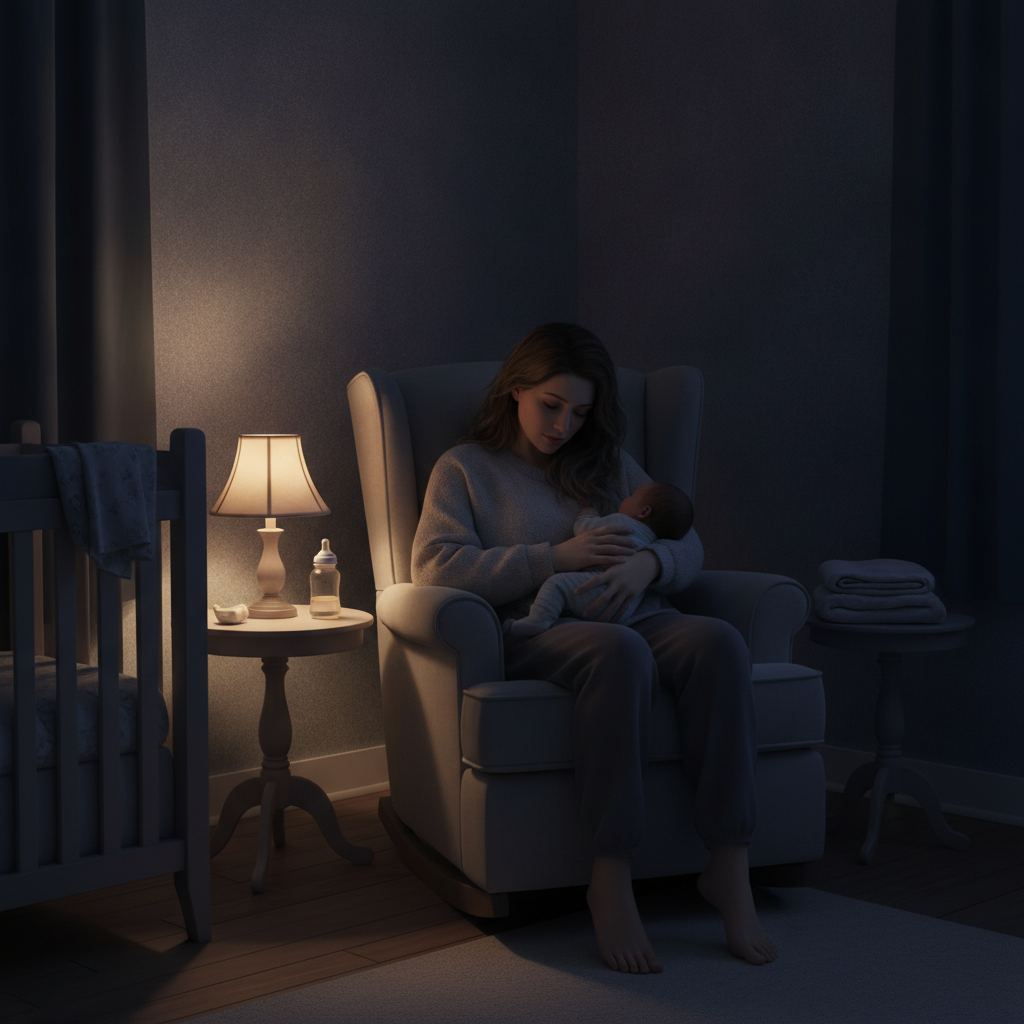
It's 3:07am. You're standing in a dark nursery, swaying a small human who was sound asleep nine seconds ago and is now staring at you like you personally ruined everything. This is the fourth time tonight. You have work in five hours.
And here's the part that makes it unbearable: you love this baby more than you've ever loved anything. The love isn't the problem. The problem is that you're running on four broken hours of sleep, you've started crying in the shower, you snapped at your partner over a dishwasher, and somewhere around week six of this you stopped believing it would ever end.
So let's say the thing the parenting blogs are too polite to say: you can adore your baby and be completely destroyed by them at the same time. Both are true. Only one of them has to change.
The lie you've been told: "Some babies are just bad sleepers"
Here's what nobody explained at the hospital. Every human on Earth — you included — sleeps in cycles, and briefly surfaces between them all night long. You surface, roll over, and dive back in without ever remembering it. Babies cycle faster than adults (45–50 minutes versus your 90), which means they surface more often.
Waking is not your baby's problem. Your baby is supposed to wake. The question that decides whether you sleep tonight is: what happens when they surface?
"A baby who falls asleep nursing wakes up 45 minutes later somewhere different from where they fell asleep — and calls for the management."
Picture falling asleep on your pillow and waking up on the kitchen floor. You'd yell too. A baby who falls asleep feeding, rocking, or in your arms wakes up between cycles in a crib — with the milk, the motion, and the arms gone. They're not hungry. They're not broken. They're confused, and they're calling for the conditions they fell asleep with.
That's it. That's the whole mystery. The babies who "sleep through the night" aren't magic babies — they're babies who fell asleep in the place where they wake up, without help that disappears. So when they surface at 11pm, 1:40am and 4am like every other baby on the planet, they grumble, resettle, and dive back down. Alone. In seconds.
Sleep is not a temperament. It's a skill. And skills can be taught — at 5 months, at 9 months, at 18 months. Usually in about two weeks.

What doesn't work (you've probably tried all of it)
- "Wait it out — they'll grow out of it." Some do… at two, three, or four years old. That's hundreds more nights like last night. Waiting isn't a plan; it's a sentence.
- Keeping them up later so they're "really tired." The single most common mistake in baby sleep. Overtired babies fight sleep harder — exhaustion floods them with cortisol, the wired hormone. In baby sleep, the fix is almost always an earlier bedtime, never a later one.
- A bigger feed before bed. If night wakings were hunger, this would work. It mostly doesn't — because most wakings after the early months aren't hunger. They're the broken-cycle problem above.
- Reading seventeen contradictory blogs at 3am. One says never let them cry. One says close the door until morning. One blames the moon. You don't need more opinions. You need one coherent plan, and the nerve to run it for two weeks.
The 5 fixes that actually move the needle
1. Make the room boring and black. Stand in the nursery with the lights off. If you can see your hand in front of your face after 30 seconds, it's not dark enough — baby eyes let in far more light than yours, and light destroys melatonin. Blackout the window, tape over the gadget LEDs. This alone fixes a shocking number of 5am wake-ups.
2. Continuous white noise, all night. Not lullabies — they end, and the change wakes babies. A steady shower-loud hum, across the room, masks the dog, the door, the garbage truck, and the sibling. It's a $20 cocoon.
3. Get the timing right. Babies have "wake windows" — stay inside them and sleep comes easy; miss them and you're fighting biology. A 7-month-old needs roughly 2.5–3 hours awake between sleeps; an 18-month-old closer to 5. Most bedtime battles are actually timing battles wearing a costume.
4. Run the same 20-minute routine, every single night. Feed → bath → pajamas → one book → one song → same goodnight phrase → crib. Babies can't read clocks, but they're world-class at patterns. The sequence becomes a row of dominoes that ends in sleep — and it works in hotels, at grandma's, anywhere.
5. The one that changes everything: into the crib awake. Not "drowsy" — drowsy is already asleep-ish, and the hard part happened in your arms. Awake. Eyes open. Mildly unimpressed, even. A baby who does the entire falling-asleep process in the crib owns a skill they reuse at 2am — without you. This is the master key, and yes, the first nights take support and courage. There are gentle ways to do it where you never leave the room.
"But I can't handle the crying"
Then don't — pick a method that matches your heart. This is the part most parents never hear: sleep teaching is not one method. It's a dial. On one end, you sit beside the crib every night, soothing with your voice and your hand, moving your chair away a little every few nights — you never leave, and it takes about two weeks. In the middle, short timed check-ins, faster results. On the other end, a slow fade with no timed crying at all.
All three reach the same place. The research on this is genuinely reassuring: decades of studies on behavioral sleep teaching find no harm to attachment, stress or development — and meaningful improvements in infant sleep and parental mental health. A loved baby with warm, responsive days and consistent nights is a baby learning a skill, not losing a parent.
What actually breaks sleep training isn't the method. It's switching methods on night four at 2am. Pick the gentlest lane you can run consistently — consistency beats intensity, every time.
What two weeks from now can look like

Bedtime takes twenty minutes: routine, kiss, phrase, door. The evening belongs to you again — dinner that's actually warm, a show, a conversation with the person you made this baby with. The night holds one feed, or none. And the baby? The baby wakes up rested — because consolidated sleep is as good for their growing brain as it is for your sanity.
That's not a fantasy. That's the standard outcome of two weeks of boring, loving consistency with a plan that respects both the science and your heart.
You've survived on broken sleep long enough to read this whole article. You don't lack strength. You lacked a map.
Baby Sleep Rescue — The 14-Night Plan
Step-by-step nights · 16 plain-English guides · 36 "3am Rescue Cards" · Smart Schedule Generator · Sleep Log · 3 bonus ebooks
$39, once. Lifetime access. And if your nights don't get dramatically better — it's free. 30-night money-back guarantee.
Start Night 1 tonight →This article is educational and not medical advice. Always follow AAP safe-sleep guidance (baby alone, on their back, in a bare crib), and talk to your pediatrician before changing sleep or feeding routines — especially if your baby was premature or has a health condition.